
From Chatbot to AI Workspace: The Emerging Problem of Context Management
The next competitive advantage in AI may not be a larger model. It may be the ability to decide what the model sees, what it can do, and what counts as done.
Everyone is shopping for a smarter AI. Almost nobody is designing its job.
That is becoming a more consequential distinction as the chat window absorbs the functions of an IDE, terminal, browser, document system, media studio, and integration hub. What began as a conversational interface is turning into a general-purpose workspace in which a model can read files, alter code, query systems, create artifacts, and leave work for another person to review.
The visible question is still: Which model is best? The harder question is: What should this model know, attend to, do, and prove at this moment?
That is the emerging problem of context management.
Chat has already outgrown chat
A conventional chatbot answers from the conversation in front of it. An AI workspace has a much larger possible field of view: project instructions, files, repositories, documentation, browser results, terminal output, connected applications, prior work, and persistent memory.
It also has the ability to act.
That changes the architecture. The model is no longer merely generating text for a human to copy elsewhere. It is participating in work. It may inspect a codebase, prepare a document, classify a request, assemble a briefing, update a work item, or hand a result back for approval.
The boundary between chat, IDE, browser, terminal, and business application is therefore becoming less important than the environment that connects them.
The Model Context Protocol is one sign of this shift. It defines a common way for AI applications to receive contextual information, expose tools, and compose integrations and workflows. The protocol explicitly treats resources, prompts, and tools as different capabilities—not as one enormous prompt. MCP specification
A large context window is a warehouse
A model with access to every file, every conversation, every policy, and every connected system is not necessarily well informed.
It may simply be distracted.
Irrelevant files compete with the task. Old decisions become invisible assumptions. Conflicting instructions create ambiguity. A useful document hidden among hundreds of less useful ones may as well be absent. And a model that can reach every tool is not an empowered employee; it is an uncontrolled integration account.
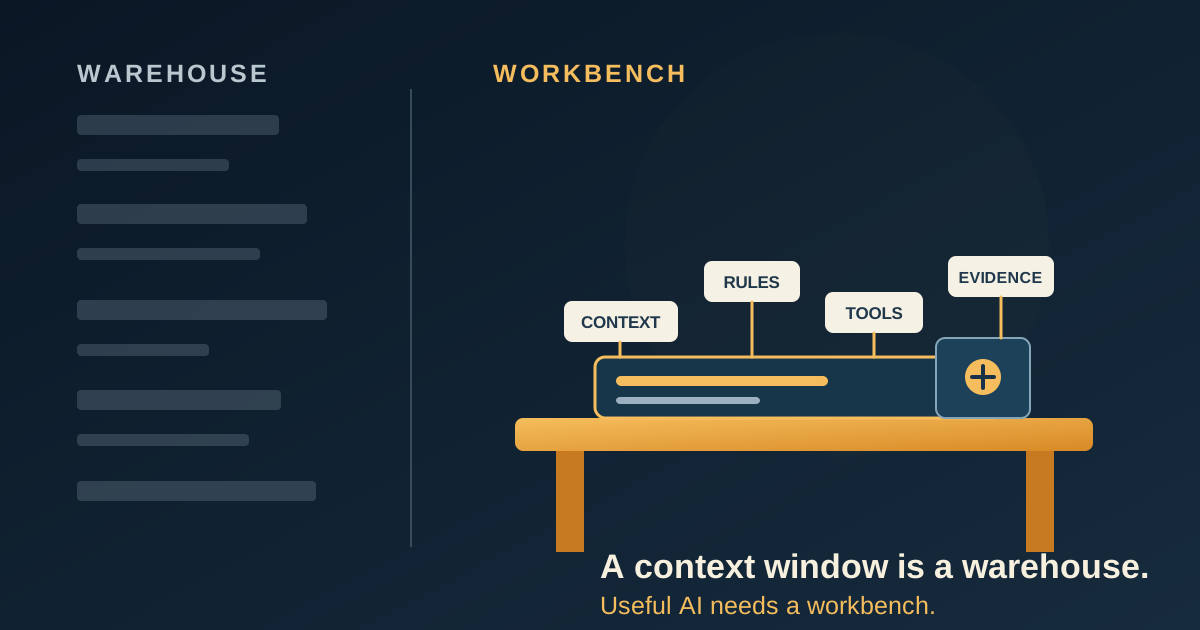
A context window is a warehouse. Useful AI needs a workbench.
The workbench contains the material needed for the decision now: the authoritative specification, relevant examples, current state, constraints, permitted tools, and a clear definition of completion. Everything else may still exist, but it should not automatically occupy the model's attention.
This is why more context is not the same as better context. Capacity matters. But capacity does not resolve relevance, authority, freshness, scope, permission, or evidence.
One engine, many specialized workers
A capable general model can appear to become several very different professionals when its environment changes:
- Give it a repository, the relevant architecture, a terminal, engineering rules, and tests: it can work as a software engineer.
- Give it a distinctive voice, source material, cultural context, editorial constraints, and a continuity check: it can help write satire, an essay, or a book.
- Give it a calendar, contacts, priorities, correspondence history, and explicit approval rules: it can operate as a personal secretary.
- Give it a defined dataset, methodology, calculation tools, and reconciliation checks: it can support financial analysis.
- Give it a production plan, recipes, inventory, sensors, and governed machine interfaces: it can coordinate parts of an embedded bakery operation.
The last example needs a firm boundary. The language-model layer might adapt a production schedule, explain an anomaly, or support an operator. It should not replace deterministic controllers, safety interlocks, or certified process logic.
The point is not that one chatbot secretly contains a programmer, a satirist, a secretary, an analyst, and a baker. The point is that the same general reasoning engine behaves differently when the system around it gives it a different role, focus, capability set, and control loop.
Model + Focused Context + Rules + Skills + Tools + Workflow + Memory + Validation = Specialized AI Worker
The terms are deliberately separate. A tool is something the model can operate. A skill is a reusable procedure for a class of work. A rule constrains what may happen. A workflow determines sequence, state, approvals, and escalation. Validation establishes whether the result is good enough to accept.
This pattern is moving from theory into product architecture. Anthropic, for example, describes Agent Skills as modular packages of instructions, metadata, scripts, templates, and resources that can be loaded progressively rather than placed in the context window all at once. Anthropic: Agent Skills
Coding made the missing layer visible
Software engineering made this problem obvious because incorrect code has a way of objecting.
If an AI coding system receives an ambiguous request, the wrong files, no execution environment, and no tests, its output may look convincing while being unusable. Changing models may help, but it does not fix the engineering system around the model.
Reliable AI coding needs a loop:
Goal → Context → Constraints → Action → Evidence → Correction
The model should understand the requested outcome and what it must not change. It should receive only the relevant parts of the codebase. It should be able to run the build, tests, linter, or a targeted inspection. Failures should return as evidence, not as an invitation to declare the task finished anyway.
The broader principle goes beyond code:
Never trust generated output; trust the process that verifies it.
Research needs sources and checks. Financial analysis needs reconciliation. A customer-service response needs policy boundaries and escalation. A document needs a review against the source material. The model's confidence is not evidence.
The business process becomes part of the runtime
This is where AI workspaces connect directly to process design.
Traditional automation routes work and data between systems. An AI-enabled process must also govern attention, tool access, authority, evidence, memory, and human judgment. It needs to decide which context belongs to a task, when an agent can act, when a person must approve, and what record remains afterward.
In that sense, a business process can become executable context for an AI worker.
A Jira issue, for example, can contain an approved request, its state, the relevant knowledge, assigned responsibility, decision gates, linked evidence, and an activity history. As argued in our earlier article, this makes Jira a plausible governance layer around agents. Jira Is Becoming the Governance Layer for Enterprise AI Agents
But the same pattern applies outside Atlassian. A claims workflow, service desk, purchase approval, editorial pipeline, or regulated production process can define the operating envelope around an AI action. The process does not have to make the model intelligent. It has to make the model's intelligence usable, bounded, and accountable.
What should enterprises design now?
The tempting response is to collect prompts. The more durable response is to design an AI work environment.
Start with a few practical questions:
- What is the authoritative context for this task? Not everything the organization knows—only what the model needs now.
- What information is stale, conflicting, or out of scope? Context needs expiry and boundaries as much as it needs retrieval.
- Which tools may the model use, under which conditions? Tool access is authority, not a convenience feature.
- What must a human approve? Approval should follow risk and reversibility, not merely organizational habit.
- What evidence proves completion? A model's prose is not sufficient proof.
- What should persist? Separate user memory, project memory, task state, and one-time working context.
These questions will outlast the current model leaderboard. Models will improve, prices will move, and interfaces will converge. The architecture that determines how a model is focused, equipped, checked, and remembered will remain.
The next competitive advantage in AI may not be owning the largest model.
It may be knowing how to give a capable model a properly designed job.