
Compound Engineering: Daily Use of the Framework
A practical guide to running the Plan → Work → Assess → Codify loop every day, so your engineering process improves with each task.
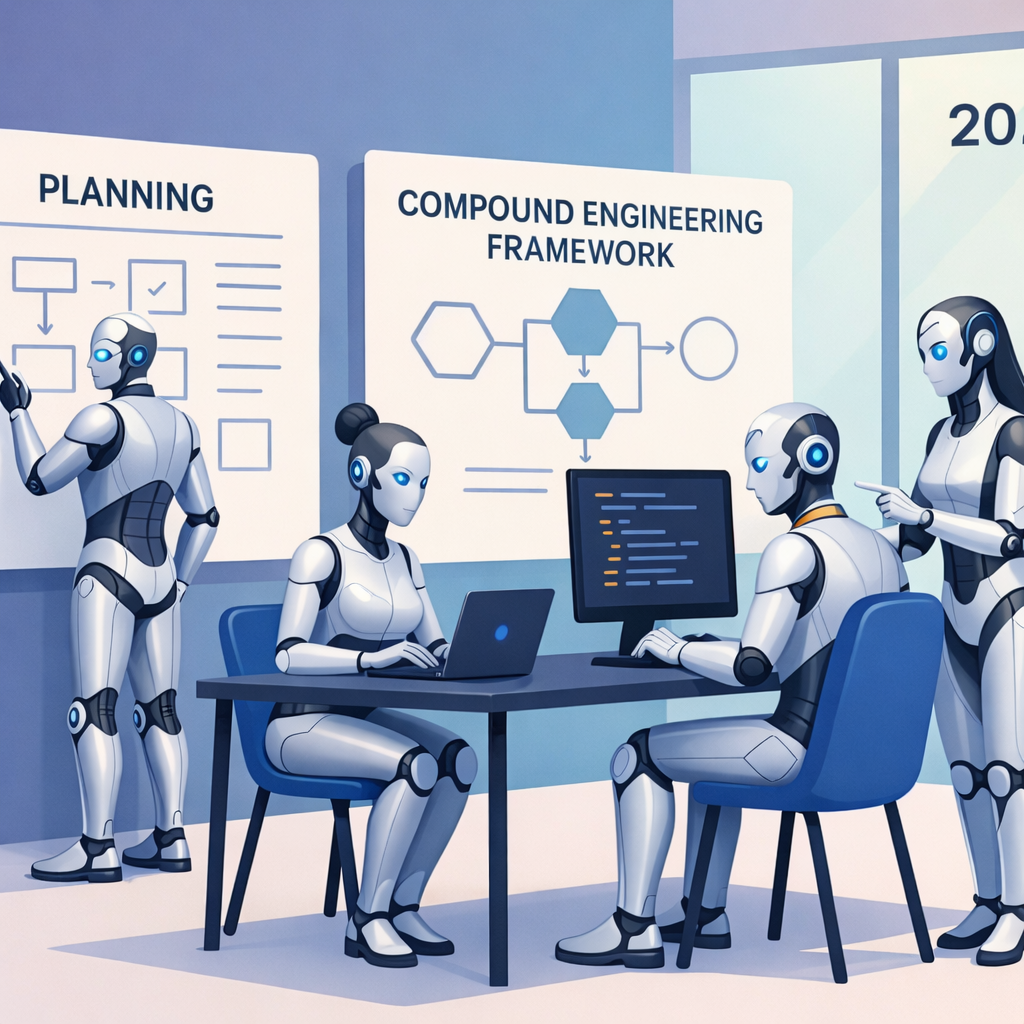
Most teams ship work. Great teams improve how they ship work.
That is the idea behind compound engineering: a repeatable loop that makes each task easier, safer, and faster than the last.
Plan → Work → Assess → Codify
Use this loop on every ticket—even small ones—and you will steadily reduce rework, bugs, and decision fatigue.
1) Plan
Goal: Produce a plan you would confidently hand to a teammate.
What to do
- Define one small, testable objective (one feature, one bugfix, or one refactor slice).
- Add constraints (for example: do not change API contracts, keep schema unchanged, maintain backward compatibility).
- Specify clear acceptance criteria.
Prompt template
- “Scan the repo, identify relevant files, and draft a step-by-step implementation plan.”
- “Include risks, edge cases, and a minimal test plan.”
- “List what is explicitly out of scope.”
Output you want
- Ordered steps
- Files likely to change
- Dependencies and assumptions
- A short test checklist
- Open questions (ideally few)
If the plan feels vague, fix it now. Ambiguity in Plan becomes churn in Work.
2) Work
Goal: Execute with focus and minimal thrash.
What to do
- Start with a clean context/session so execution follows the plan, not chat drift.
- Provide the plan and enforce it: “Implement this plan exactly. If you must deviate, stop and explain first.”
Guardrails
- If clarifying questions appear, answer briefly and move on.
- If scope expands, pause and restate acceptance criteria.
- If complexity rises, cut scope before adding abstractions.
A strong Work phase is boring by design: predictable, incremental, and easy to review.
3) Assess
Goal: Validate correctness from multiple angles.
Minimum checklist
- Behavior: Happy path plus 1–2 important edge cases.
- Tests: Run relevant existing tests; add new tests where they increase confidence.
- Security: Authentication, authorization boundaries, input validation.
- Simplicity: Fewer moving parts; avoid unnecessary abstractions.
- Consistency: Match repository patterns and conventions.
High-leverage tactic: role-based review
Run lightweight reviews from different perspectives:
- Security reviewer
- Architecture reviewer
- Simplicity/maintainability reviewer
- Product/UX reviewer (when user-facing)
Ask each reviewer to classify findings:
- P1 — Must fix before merge
- P2 — Should fix soon
- P3 — Nice to have
This creates shared severity language and prevents “everything is urgent.”
4) Codify (the compounding step)
Goal: Convert today’s mistakes into tomorrow’s defaults.
When you notice repeatable friction, turn it into a rule instead of a reminder.
A) Always-on rules (for frequent mistakes)
Store in a persistent project memory file (for example, CLAUDE.md):
- Prefer one settings update tool.
- Never edit migrations manually; use scripts.
- When touching auth, always add unauthorized-access tests.
B) Just-in-time rules (for niche workflows)
Write short docs that are loaded only when relevant (for example, release steps, incident playbooks, import procedures).
C) Architecture decisions (for recurring design tradeoffs)
Create concise ADRs with:
- Context
- Decision
- Consequences
- Example
This prevents re-litigating the same decisions every sprint.
A practical starter version
If you want a simple default you can apply today:
- Plan: Draft steps + a small test checklist.
- Work: Implement only the approved plan.
- Assess: Run tests + security/simplicity review.
- Codify: Capture one new rule in your team memory file.
Run this loop for a few weeks and compare outcomes: cycle time, escaped defects, and number of repeated mistakes.
Common failure modes
- Skipping Codify, so every task feels new.
- Assessing by intuition instead of checklist.
- Allowing scope creep during Work instead of tightening Plan.
Compound engineering is not about perfection. It is about reducing avoidable mistakes, one loop at a time.